Hardcore learning
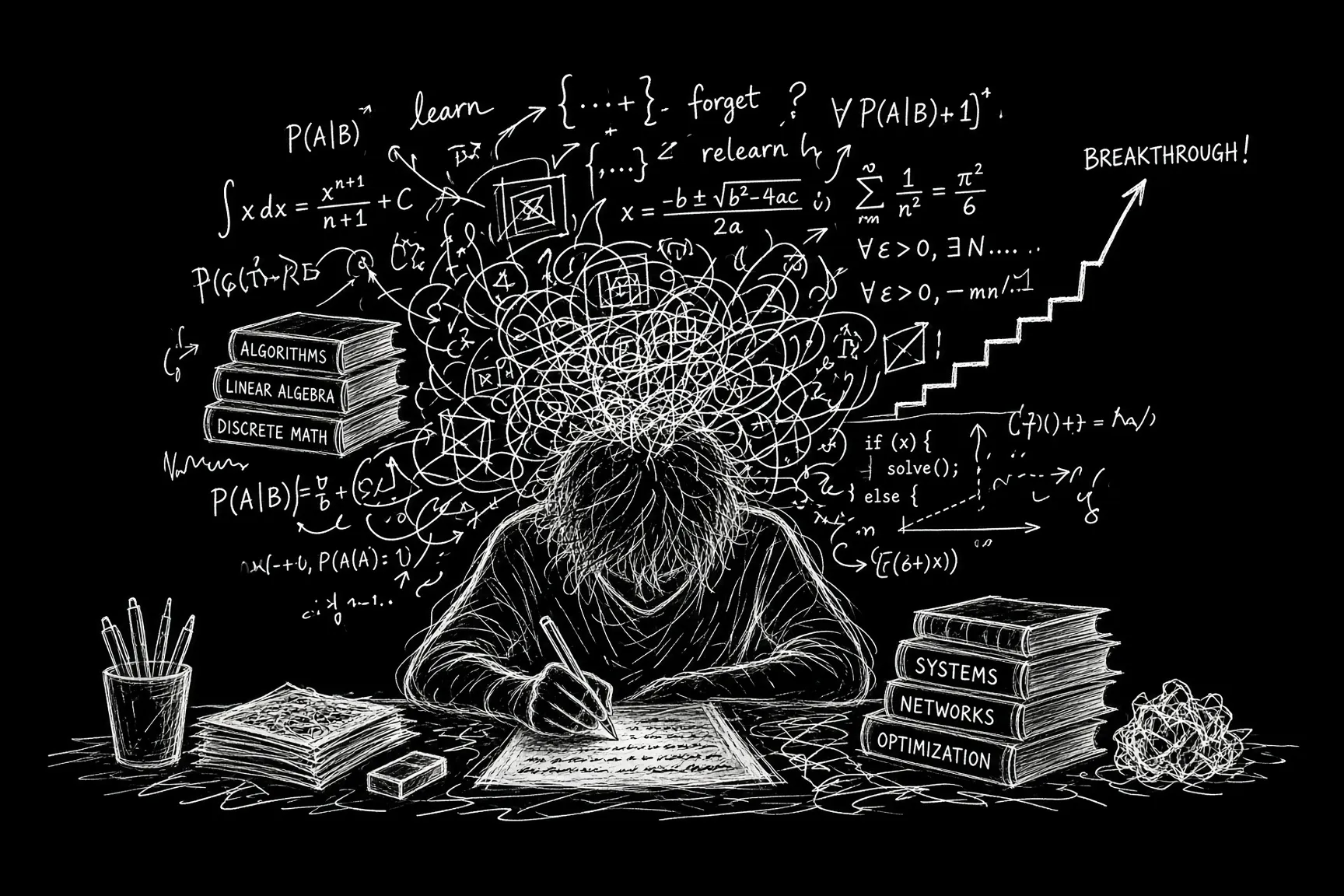
A practical method to master a subject as efficiently as possible, built for long-term retention rather than short-term exam performance.
These principles come from lived experience: earning a law degree after a decade as a carpenter, writing a mathematics book for students, then pivoting after an accident to become CTO of a startup and building a modern web application from the ground up.
This is not a guide for someone starting from zero who needs to pass a test next week. It is for integrating knowledge deeply enough that it sticks and compounds over time.
I. Mindset and Constraints
There is no easy way
Mastering anything is hard. Mastering it quickly is harder.
Anders Ericsson’s research suggests roughly 10,000 hours of deliberate practice for true expertise. At 15 hours a day, that is about two years. You will almost certainly need less for your specific goal, but the core point remains: sustained, uncomfortable effort is required.
Leaving a comfort zone feels risky while it is still theoretical. Once you begin, the difficulty becomes real. Doubt will appear. That is normal.
Personal reference point: roughly 1.5 years of ~17-hour days of professional learning and practice produced real confidence in software development. Basic API and frontend deployment was already possible within two weeks of focused work.
Know your goal
Every technical subject branches into many others of equal depth. Define what “done” looks like for you and at what level.
Between zero and one there is already infinity. The same applies to knowledge.
Know yourself
Push hard, but not so hard that you destroy confidence or self-respect. You will need both later.
Know the people around you
If you live with a partner or family:
- They do not want to hear every detail of what you are learning all day.
- Your comfort-zone shift will affect theirs. Agree in advance on what is sustainable for the household.
Be realistic about available time
Someone who works a normal schedule for a year can often be matched in six months by someone working twice as hard. Not everyone can sustain 30-hour stretches. Fit the intensity to what you can actually maintain.
You will succeed if you stay with it
The useful working motto is: if another human did it, you can too.
This does not apply to rare physical extremes (running 100 m in 9.57 seconds), but it covers the vast majority of intellectual and technical goals. The two requirements are time and energy.
Progress is not linear
You advance in steps. Each step rests on the previous work and typically takes longer than the one before it. The main risk is becoming comfortable at a given plateau and staying there.
Speed requires extra focus
Listening or watching material at 1.25× or 2× is useful for easier sections. It demands more attention, not less.
Just do the work
This assumes you can already sit with the material for long stretches without constant distraction. Two practical notes:
- Procrastination is a lose-lose. Doing something else instead of the work leaves you both behind and unsatisfied. Reverse the order: complete a set block of work first, then take the reward. Interest in the distraction usually drops.
- Do not wait for the perfect setup. You do not need expensive equipment or ideal conditions to start.
- Activity produces more activity.
II. Method
Dig deep
Learn definitions properly and understand them. Surface familiarity does not produce confidence.
Always study something slightly too hard
Stay one step above your current level. Remaining at the same difficulty for too long is the larger risk.
When you later return to earlier material, it feels easier and you use it more creatively. The same pattern appears when moving between school grades.
Step back regularly
Progress does not have to be strictly linear. Move one step ahead and one step back in parallel. Revisiting easier material after harder work deepens understanding.
The effect is similar to rewatching a film: you notice new details or interpret scenes differently once you know the ending. The size of the steps can vary.
Learn, understand, practice
Practice from day one. It reveals what the theory actually means. All three are required.
Memorize by heart
Repeated exposure eventually produces sudden deeper understanding. Some people do this out loud or in front of a mirror.
Expect to forget
Forgetting is part of the process. One useful framing from a law teacher: learn, forget, relearn, forget again—as many times as needed. Real retention often begins on the third cycle. It becomes easier with practice and expertise.
Use multiple strategies
Some people retain better by reading, others by writing, listening, or explaining. Use more than the method you find most comfortable, even if that preferred method remains primary.
Consume primary material and current discussion
Read documentation. Listen to podcasts and debates in the field even when you do not understand everything yet.
Push to the breaking point, then rest
Taking the brain to the edge of what it can handle is useful. Some claim learning while exhausted is worthless. The opposite may be true: it can be the moment new connections form more deeply. The brain is plastic; the new pathways must be forced.
Strategy: push to the limit, then rest. Progress becomes visible afterward.
Failure is part of the process
Moving between comfort zones feels dangerous. Failure is expected and useful.